



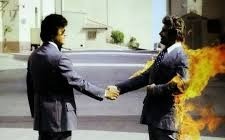
Ronnie Rondell Jr., the Hollywood stuntman who literally set himself on fire to create Pink Floyd’s legendary “Wish You Were Here” album cover, died August 12 at age 88 in a Missouri care center. While you might not know his name, you’ve definitely seen his work—that haunting image of two businessmen shaking hands while one burns has become as synonymous with 1970s rock as vinyl records themselves.
Rondell’s willingness to risk everything for art didn’t just capture a moment; it crystallized an entire generation’s relationship with corporate alienation and artistic rebellion. His death, reported by multiple news outlets including RNZ and Sky News, closes the book on a career that spanned over five decades and 200 film productions.
Fifteen Takes and One Perfect Burn
The iconic 1975 photoshoot required extreme precision and resulted in actual injury that became rock history.
The Warner Bros. lot photoshoot with Hipgnosis photographer Aubrey Powell demanded something most fire stunts avoid—standing completely still while engulfed in flames. According to reports from retrospective interviews, fifteen takes using flame-retardant gel were required before achieving the perfect shot.
A sudden wind shift on the final attempt burned Rondell’s face, but that unplanned moment of genuine danger became the image that graces one of progressive rock’s masterpieces. The technical challenge was unprecedented: fire stunts typically involve movement or distance, but this required motionless precision that pushed stunt work into fine art territory.
Building an Industry Institution
Stunts Unlimited revolutionized how Hollywood approached dangerous action sequences and performer safety.
Co-founding Stunts Unlimited in 1970, Rondell helped transform stunt work from reckless daredevilry into disciplined artistry. His extensive filmography includes “How the West Was Won,” “Diamonds Are Forever”, “Blazing Saddles,” “Lethal Weapon,” and “The Matrix Reloaded”.
During Hollywood’s practical effects golden age—before CGI replaced human risk-taking—Rondell’s innovations in flame-retardant technology and safety protocols kept performers alive while delivering visceral thrills. His technical expertise elevated the entire profession from dangerous spectacle to calculated craft.
Legacy Beyond the Flames
Rondell’s influence shaped both cinematic action and music’s visual culture for decades.
Beyond his Pink Floyd immortality, Rondell mentored generations of stunt professionals who carry his safety-first philosophy into today’s action cinema. His technical expertise bridged the gap between Hollywood’s studio system and rock music’s emerging visual sophistication, proving that true artistry often requires genuine risk.
That burning businessman didn’t just sell albums—it established a template for how music and film could collaborate to create lasting cultural artifacts that transcend both mediums. Rondell’s legacy lives on in every carefully choreographed action sequence and every album cover that dares to push visual boundaries.