


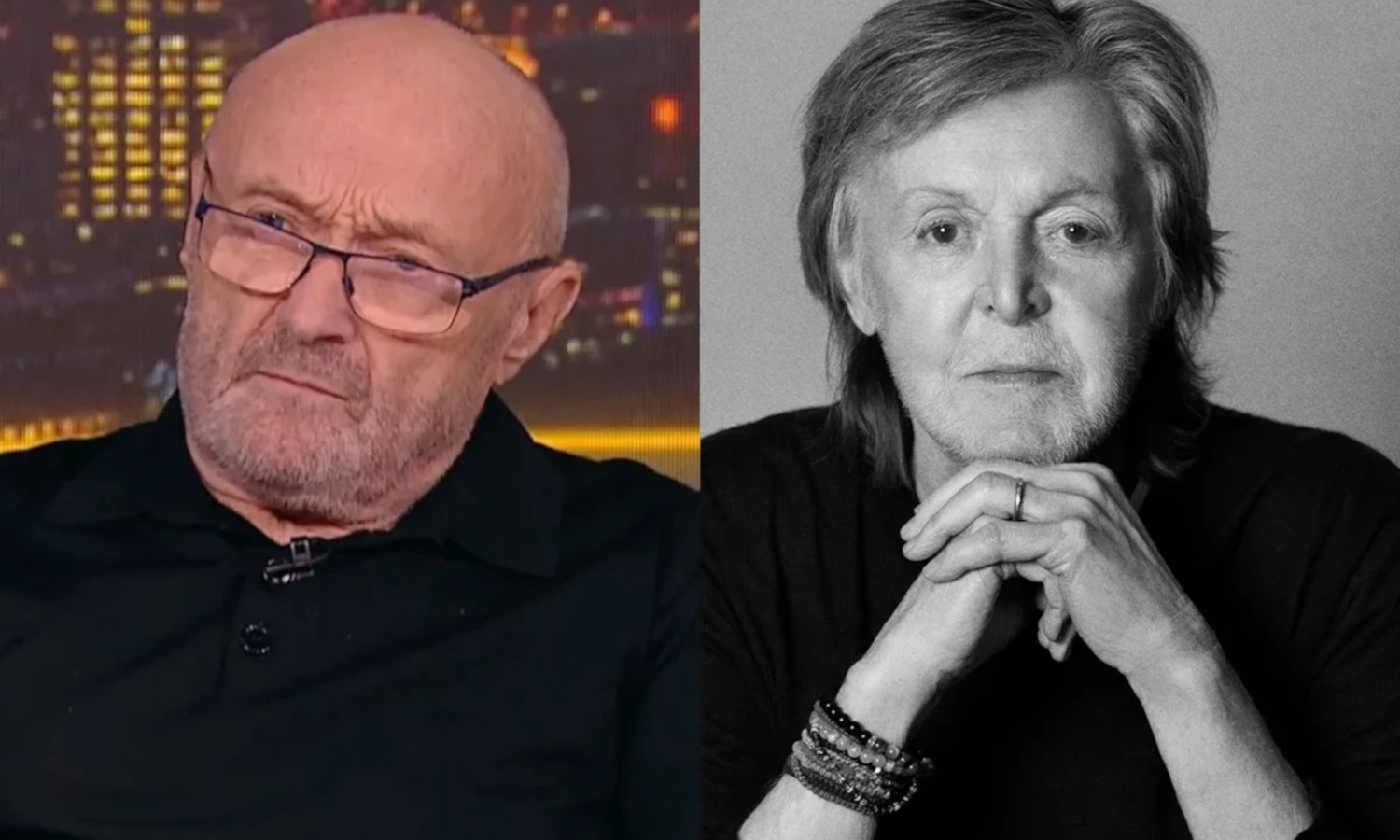
Some grudges survive reconciliation like a bassline buried in the mix — technically resolved, still audible if you know where to listen. At a London Q&A celebrating the 45th anniversary of his 1981 debut Face Value, Phil Collins told the audience that something was missing from the streaming reissue of The Beatles Anthology. Specifically: George Harrison, talking about Collins’ cover songs — his version of “Tomorrow Never Knows.” According to Collins, the original 1995 documentary included Harrison referencing the track after the Beatles had listened to it on multitrack tape. Collins was proud they “mentioned my name.” Then the Disney+ version dropped, and the moment was gone.
His read on why? “maybe McCartney didn’t like it.”
What’s Actually Known
The gap between Collins’ observation and his speculation matters — and in this case, that gap is significant.
- Collins noticed the Harrison reference had been removed after watching the reissued Anthology on streaming, including Disney+
- The original 1995 version reportedly included Harrison acknowledging Collins’ interpretation of the track
- No public explanation has been identified for the editorial change — not from the production team, not from Apple Corps, not from anyone
- No public response from McCartney to Collins’ latest comments has been identified in available reporting
An Old Score, Freshly Scratched
The Collins-McCartney friction predates this moment by more than two decades, tracing to a 2002 Buckingham Palace concert that Collins has never quite let go of.
This tension has roots in a 2002 encounter during Queen Elizabeth II’s Golden Jubilee concert at Buckingham Palace. Collins asked McCartney to sign a first-edition copy of Hunter Davies’ The Beatles. According to Collins, McCartney turned to then-wife Heather Mills and said, “He’s a big Beatles fan, is our little Phil?” Collins found it patronizing. He went public with the grievance, then apparently regretted it — later acknowledging McCartney probably did not mean the remark as it sounded, and saying he wished he had never spoken about it publicly. The pair reportedly reconciled, with Collins describing the matter as settled between them.
Which makes his latest comments a curious move. His phrasing — “maybe McCartney didn’t like it” — is casual enough to pass as a joke, pointed enough to land as an accusation. No evidence links McCartney to the edit. These kinds of public disputes between Band Members often have complicated histories; documentary reissues get revised for any number of reasons:
- rights clearances
- runtime adjustments
- archival quality
- editorial decisions made well below the artist level
These remain hypothetical possibilities; nothing in available reporting connects any of them to this specific change.
Collins reportedly spotted something real. His explanation for it remains unsubstantiated speculation — the kind of public grievance that recalls some of history’s most notable rock star meltdowns. McCartney, so far, isn’t talking — and the actual reason that moment disappeared may be far less dramatic than the story currently suggests.