


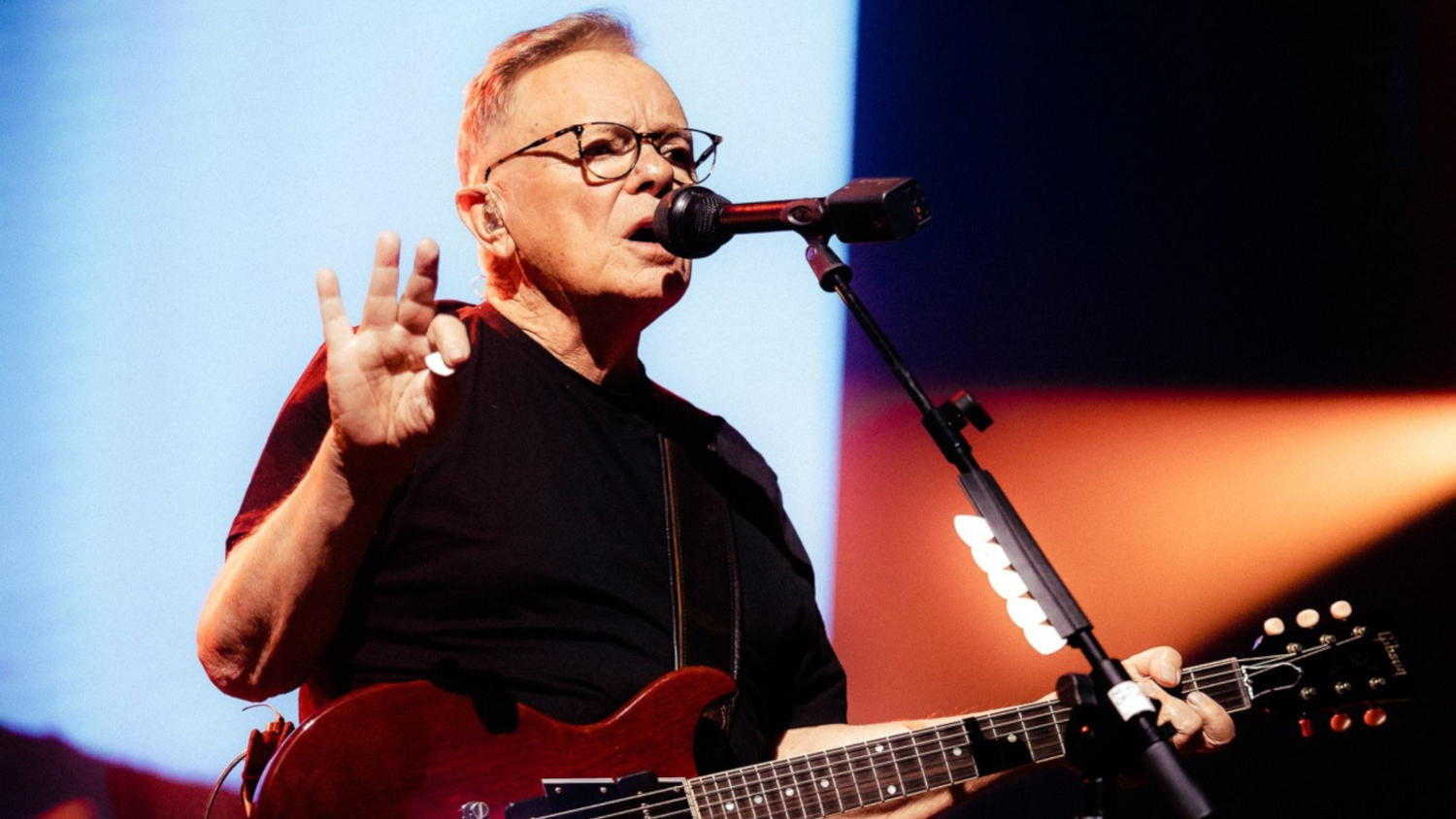
Bernard Sumner addressed the approximately 8,000-capacity Espaço Unimed after the second song of the night. “We’re sorry Steve and Gillian can’t be here with us,” he said, “and we just want them to know how much we’re missing them.” That statement — quiet, direct, unrehearsed in feeling — framed everything that followed. New Order then played 16 more songs, and barely a note felt wasted.
A Revised Lineup Holds the Line
Severe weather delayed the start, but when New Order finally took the stage on November 23, 2026, the lineup was honestly, visibly different.
Elliot Barlow stepped in on drums, handling percussion for the full South American run in place of Stephen Morris. Phil Cunningham, New Order’s longtime guitarist, absorbed keyboard duties alongside his own role — covering the textural ground Gilbert typically occupies while managing his own parts. Bernard Sumner performs as the only original New Order member in the current touring lineup.
The setlist arc told its own story:
- “Transmission” (Joy Division) opened the night
- The main set moved through “Age of Consent,” “Bizarre Love Triangle,” “True Faith,” “Blue Monday” and “Temptation,” among others
- The encore closed with “Atmosphere” and “Love Will Tear Us Apart,” Ian Curtis’ image displayed on the venue screens during both songs
Gillian Gilbert clarified her absence in a statement reported by Rolling Stone: “It is in fact me, who like many other people, is living with cancer.” Morris has stepped back from international touring. No return date appears in the available reporting for either.
The South American run continues with a second São Paulo show, then dates in Chile, Argentina, Peru and Colombia. North American shows are scheduled for spring.
Joy Division’s Ghost, Still Present
This band has always performed with its full history visible — and the São Paulo setlist made that continuity impossible to miss.
New Order formed from Joy Division’s wreckage after Ian Curtis died in 1980. That origin has never been something the band hides. Opening with “Transmission” and closing with Curtis’ image on the screens wasn’t a nostalgic gesture. It was a band insisting, again, that its past and present exist in the same breath.
Barlow and Cunningham carried the technical weight of two absent members without overcrowding the music. The sound held. Sumner’s choice to tour — and to speak plainly about who wasn’t there — gave the audience something most concerts don’t: the unvarnished truth about what they were watching, and why it mattered anyway.