


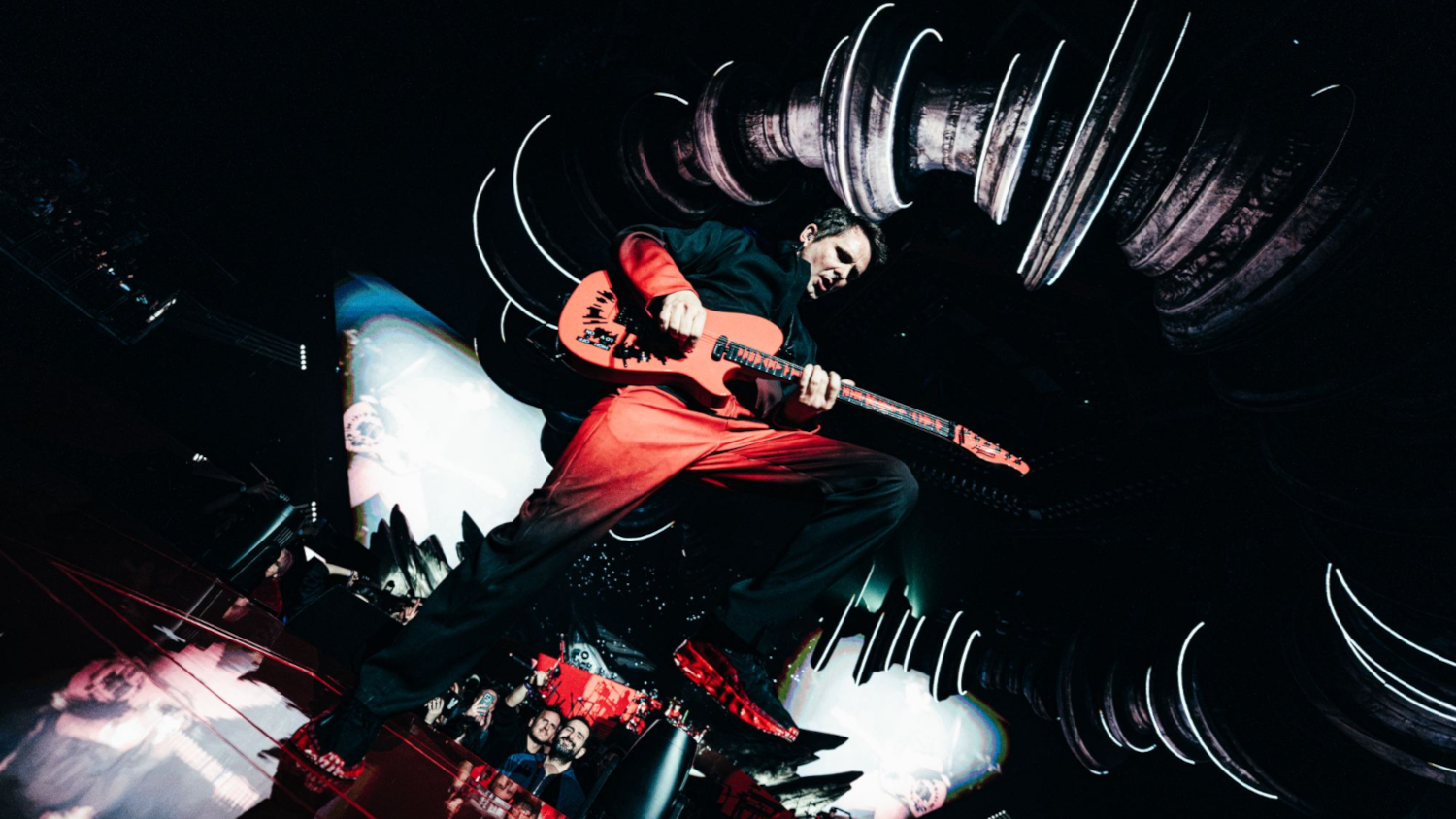
The most memorable performer at Muse‘s O2 London show on November 15 wasn’t Matt Bellamy. It was Ameca — a humanoid robot stationed near the back of the standing area, apparently running the sound desk, and occasionally singing. That’s the production logic behind The Wow! Signal tour, built around Muse’s 10th studio album and its themes of artificial intelligence, cosmic dread, and science-fiction spectacle. If you expected a standard arena night, Ameca was your first correction.
Jupiter’s Moon Called. Muse Answered.
The staging reached for the cosmos and very nearly got there.
The opening sequence referenced the real Wow! Signal — a 72-second radio burst detected on August 15, 1977, still unexplained — before a three-dimensional waveform structure dominated the stage and visuals evoking Jupiter’s moon Europa filled the screens. Bellamy emerged not from the main stage but from a floating hexagonal B-stage during “Hexagons,” surrounded by laser work that reportedly strained the production’s budget considerably. Bellamy told NME — in a paraphrase, not a direct quote — that the band had considered building a spaceship and wanted unprecedented laser design, both ambitions that apparently carried serious financial challenges.
What Ameca Actually Did
The humanoid robot wasn’t set dressing — it had an actual job.
Positioned near the standing area’s rear, Ameca operated apparent sound-desk controls at points during the show. The robot contributed vocals to reworked versions of “Kill or Be Killed” and “JFK” — the latter presented as an extended remix — and delivered the drill-sergeant introduction to “Psycho.” Think HAL 9000 if HAL had a gym membership. “Undisclosed Desires” received a synth-pop makeover that shifted the set’s texture mid-show, and the encore, “Take a Bow,” landed as a quiet nod to Black Holes & Revelations‘ 20th anniversary. For more on the Revolutionary Instruments shaping live music today, the futurist angle runs even deeper.
The setlist balanced seven Wow! Signal tracks against catalogue anchors. The Wow! Signal tracks included:
- “Hexagons”
- “The Sickness in You & I”
- “Unravelling”
- “Cryogen”
- “The Dark Forest”
- “Be With You”
- “Nightshift Superstar”
The catalogue anchors included:
- “Hysteria”
- “Supermassive Black Hole”
- “Plug In Baby”
- “Knights of Cydonia”
The full reported setlist also included “Interlude,” “Madness,” “Hanging in Victory Square,” “Time Is Running Out,” “Uprising,” “The 2nd Law: Isolated System” (Dan Lancaster remix), “Algorithm,” “Undisclosed Desires,” “Stranger Things Theme,” “Prelude,” and “Starlight” before the encore. Bellamy closed “Starlight” wearing LED glasses and a light-up jacket. NME described The Wow! Signal as Muse’s most consistent and satisfying album since Black Holes & Revelations, awarding it four stars — though that remains one publication’s assessment rather than any settled consensus.
The Tour Moves On
London was only the beginning of a run that spans the continent.
The second London date follows on November 16, before the production travels to:
- Berlin
- Milan
- Düsseldorf
- Paris
- Amsterdam
- Montpellier
- Zürich
Whether Ameca travels with them — or becomes a permanent fixture of Muse’s live setup — remains unconfirmed. What is clear is that Muse just raised the bar for what AI-assisted performance can look and sound like inside an arena.