


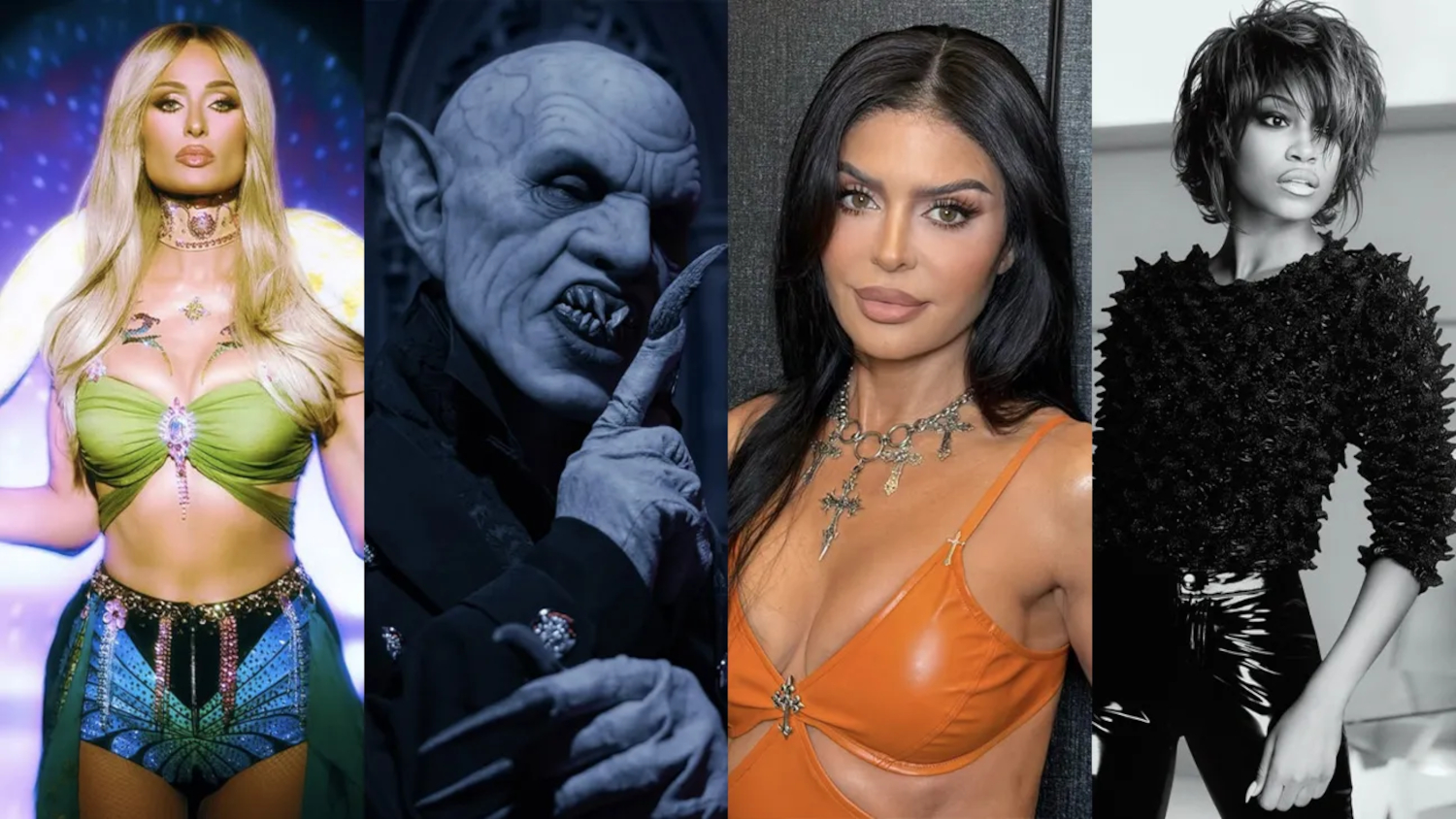
Halloween 2026 didn’t do disguise. The strongest celebrity costumes this year functioned less like party tricks and more like miniature tribute acts — precise, referential, and built for the social-media clip that travels further than any press release. When Heidi Klum spent approximately six hours climbing inside a prosthetic replica of her own severed hand, veins and tendons rendered in full, the holiday’s transformation into full-scale entertainment production felt complete.
Tribute Acts and Origin Stories
From Elvis to the X Factor, Harry Styles turned Harryween into a living autobiography.
Harry Styles opened his Madison Square Garden Harryween show as Elvis Presley, then changed into the outfit he wore for his 2010 X Factor audition — the night he performed Stevie Wonder’s “Isn’t She Lovely” and became, well, Harry Styles. It’s costuming as origin story, your whole mythology compressed into one costume change. Olivia Rodrigo pulled a similar move on her Unraveled tour stop in Columbus, Ohio, folding Marie Antoinette and zombie-ballerina looks directly into her concert production, per NME. Halloween didn’t interrupt the show. It became the show.
The standout looks from the rest of the weekend:
- Lizzo and Rita Ora both channeled Dolly Parton’s glamorous 1970s styling; Lizzo used Instagram to recall the late country singer’s support of her
- Keke Palmer dressed as Janet Jackson while her three-year-old son Leodis went as Michael Jackson, recreating the black-and-white futuristic styling from the siblings’ 1995 “Scream” video
- Paris Hilton recreated Britney Spears’ 2001 MTV VMAs “I’m a Slave 4 U” performance, snake motif and all
- Zendaya appeared as Halle Berry at the 2000 New York X-Men premiere — patterned bikini top, low-rise trousers, short hairstyle
- Janelle Monáe’s Wondaween delivered two original characters: The Amazing Phish Boy, a human-fish hybrid with vintage circus-performer energy, and Mother Creature, built on extensive grotesque prosthetics
These looks turn Halloween into shared pop-cultural memory — current stars publicly acknowledging the icons and moments that shaped them, which is arguably more interesting than any new interview. The most viral combinations tend to pair instant recognition with genuine transformation: you clock Zendaya-as-Berry in half a second, then spend the next ten minutes thinking about it.
Then Lily Allen arrived dressed as a Ticketmaster seating map.
White puffer jacket. Blue-dot bodysuit. A thermometer, presumably measuring the exact temperature of fan frustration. The costume referenced “blue dot fever” — the phrase that circulated around disappointing ticket availability on the North American leg of her West End Girl tour, according to NME. Allen’s look required zero explanation for anyone who’d recently tried to buy a decent seat to anything. Specific, self-aware, and genuinely funny — the sharpest piece of political commentary of the night, delivered via bodysuit.
When the Costume Is the Show
Heidi Klum’s annual New York party once again set the benchmark for sheer Halloween production scale.
Klum’s costume — months in preparation and approximately six hours to put on, with her face invisible inside the prosthetic — drew some of the night’s widest coverage, per NME. Elsewhere, Wolf Alice leaned into The Lost Boys‘ punk-vampire aesthetic, Yungblud went traditional vampire, Sabrina Carpenter appeared as Penny Pingleton from Hairspray, and Perrie Edwards channeled Cruella de Vil. Celebrity Halloween production value keeps climbing, and that signals something worth noting about where the holiday sits in entertainment culture — increasingly less a night off, more a deliberate extension of an artist’s public identity.
The most memorable costumes of 2026 weren’t about hiding. They were about recognition — watching someone you admire pay careful, specific respect to someone they admire. That’s a strange and genuinely moving thing to witness, even when it arrives wrapped in a blue-dot bodysuit.